UI/UX DESIGNER
An operations dashboard built to turn gym setup into accurate, scalable profiles that translate clearly to the app.
Oct 2025 - Jan 2026
4 Minute Read

The Problems
Complex Gym Profile Setup
Creating a gym required configuring profile details, contacts, pricing, and bundles across constrained screens, making setup difficult to reason about and easy to misconfigure.
Limited Outcome Visibility
Admins configured gyms without clearly seeing how their choices would appear in the mobile app or affect the final gym listing.
Design Process
Feature Level
the Primary action the user should take.
What success looks like for that interaction?
Page Level
Each screen was evaluated against a single question:
Does this move the user closer to the feature’s goal?
Screens that introduced unnecessary steps, unclear hierarchy, or competing actions were reworked or removed.
Iteration & Refinement
I iterated on layouts and flows to reduce the number of steps, clarify decision-making, and strengthen visual hierarchy—prioritizing clarity over feature density.
The Solutions
Broke onboarding into focused steps
Reorganized onboarding into structured steps for gym details, contacts, pricing, and bundles — enabling multiple contacts per gym without overloading a single screen.


Live App Preview
Introduced a live preview that reflects gym details, bundles, and pricing in real time during configuration.
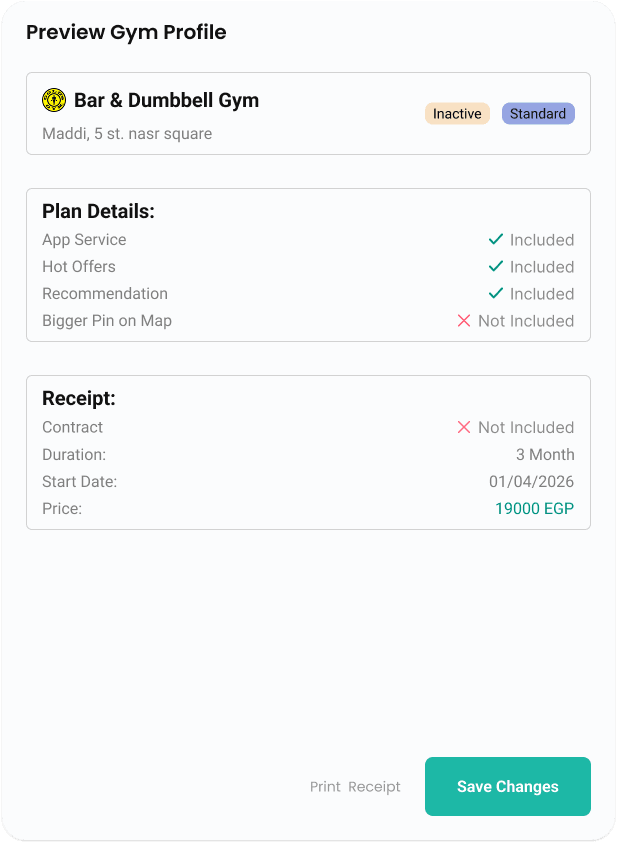
Clear Summary
Displayed pricing and included features in a single summary so admins could review agreed gym terms before publishing.
Design Impact (pre-launch)
Reduced onboarding errors by structuring gym configuration into clear, focused steps.
Aligned dashboard setup with the live mobile experience.
Enabled review of pricing and features before publishing.
Scaled contact management per gym.
Embedded internal task coordination.
What I’d Measure After Launch
Time required to set up a gym profile
Frequency of subscription and pricing corrections
Usage of the app preview during configuration
What I’ve Learned
Internal tools should prioritize clarity and safeguards over visual polish.
Explicit dependencies reduce errors more effectively than explanations.
Iteration guided by clear goals leads to more reliable configuration flows.
Admin design decisions should always be evaluated by their user-facing impact.